Five steps from the field to the market, built as one
From field equipment to the control screen, and on to KEPCO and the power exchange — one energy platform that collects, decides, controls, monitors and links to the market.
From the field to the market
Each plant’s field RTU connects to the server over an encrypted VPN. Even if the server link drops, the field RTU decides on the safe side by itself.
Four layers
Upper layers stand only on solid lower ones — ENERBOT was built from the bottom «field» layer up.
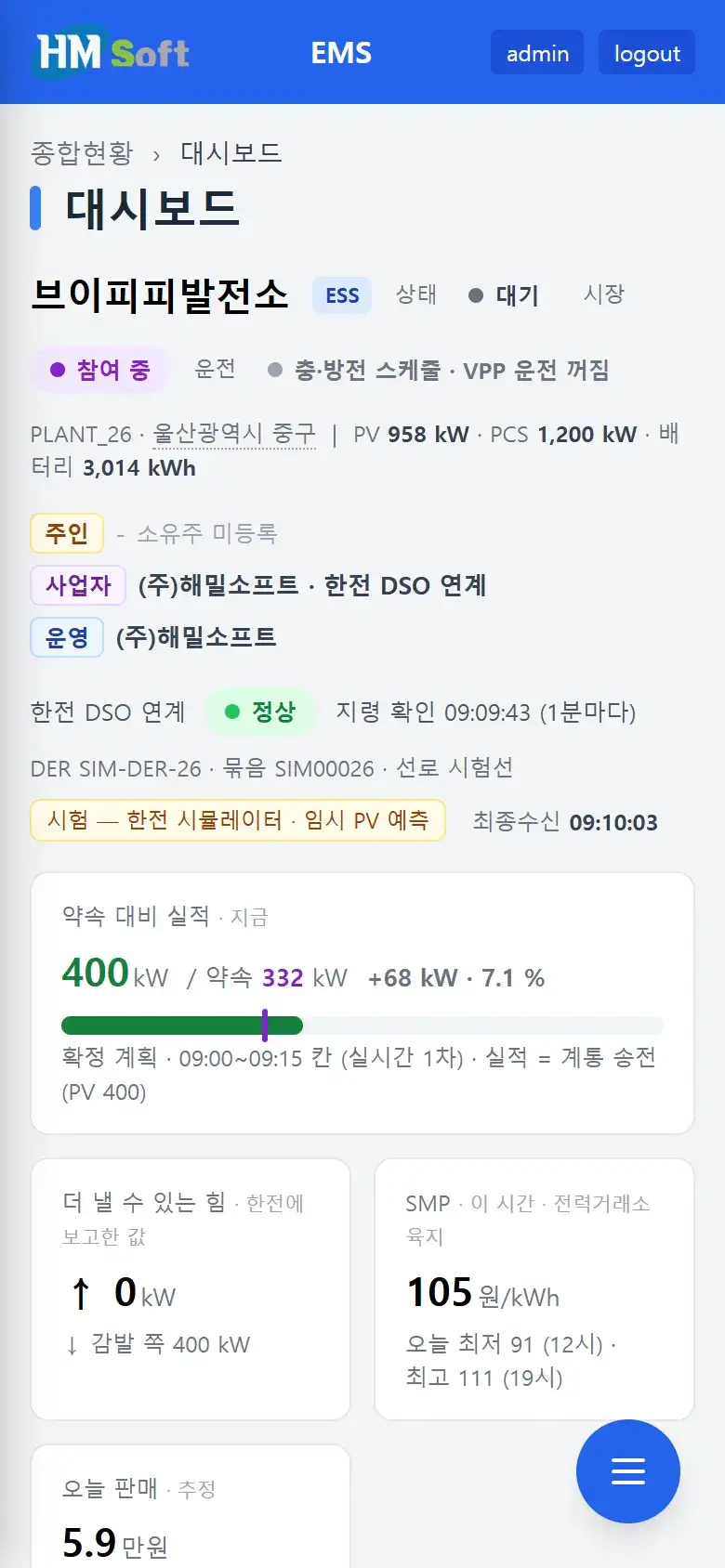
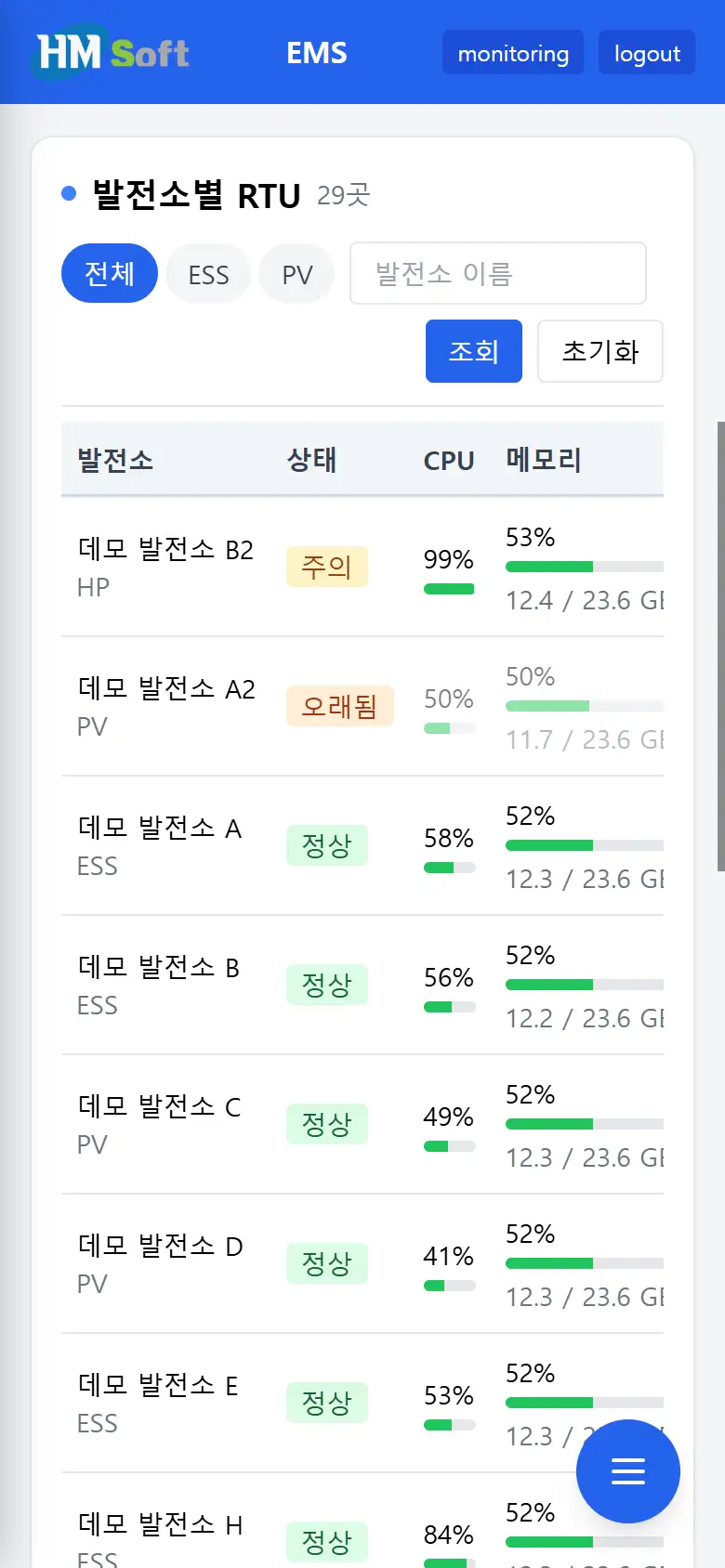
In the control room and on your phone
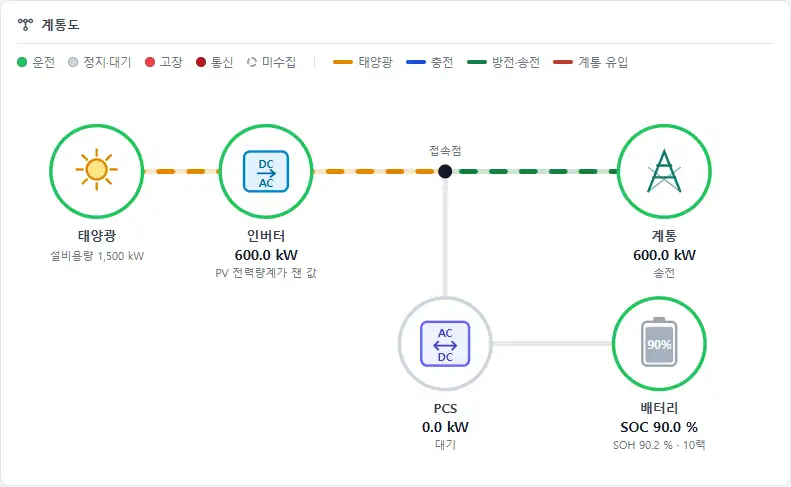
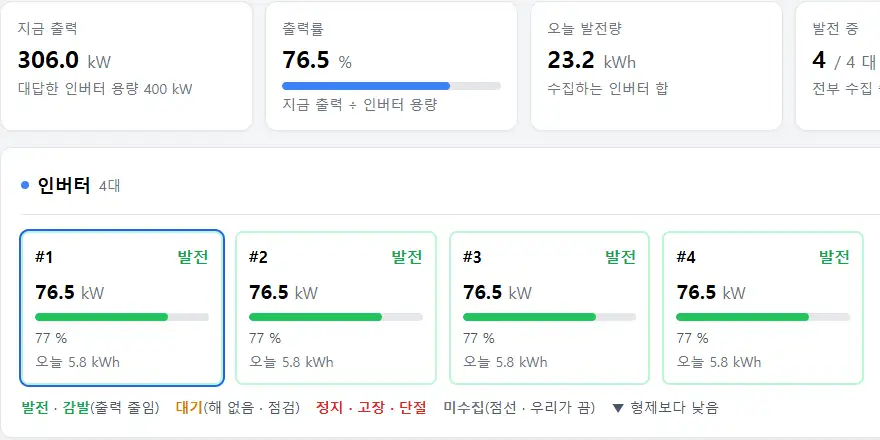
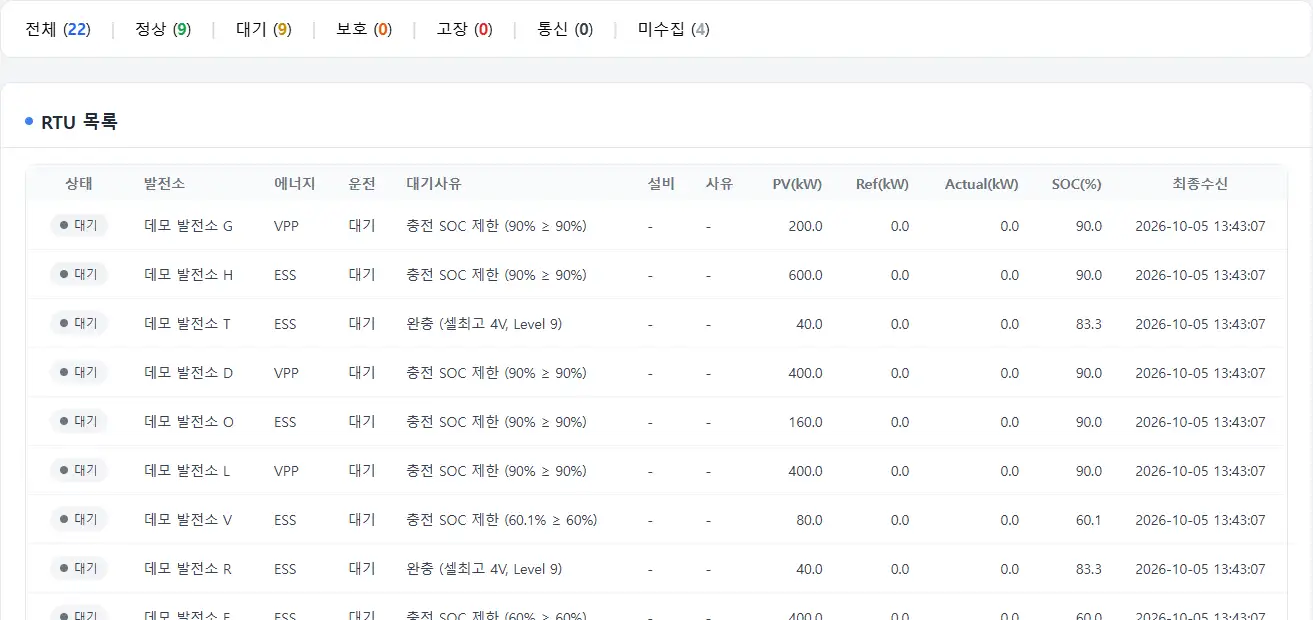
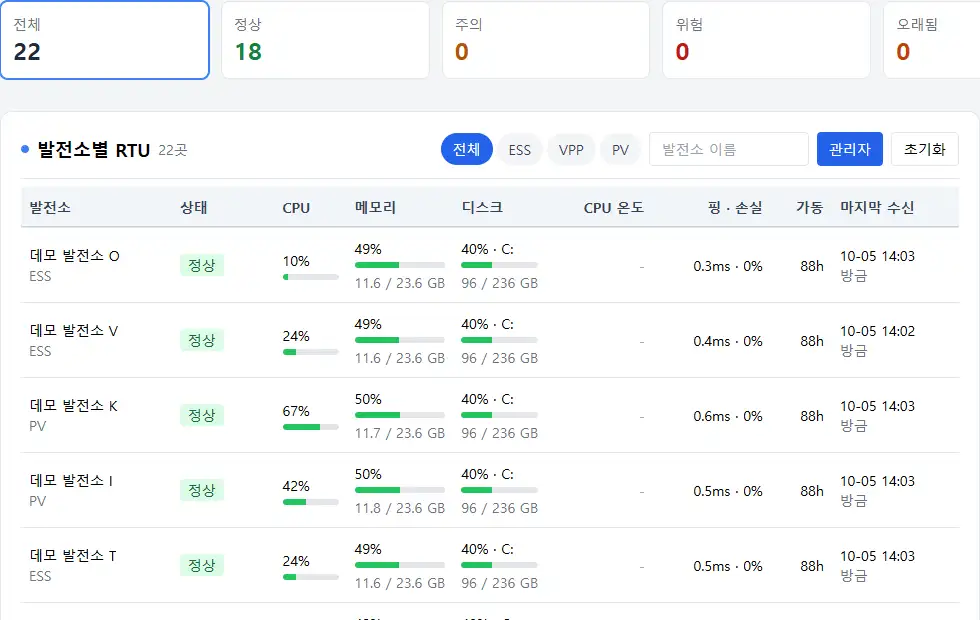
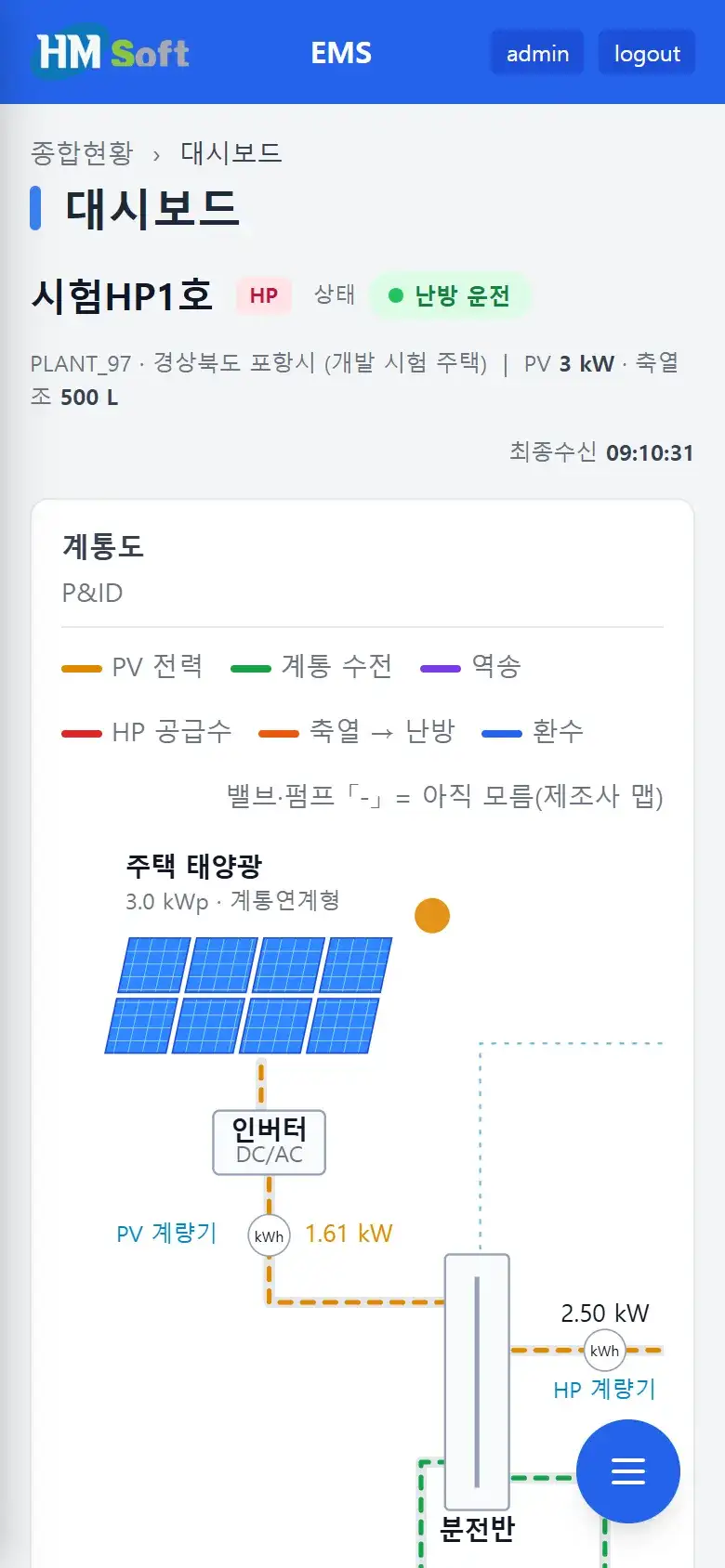
Screens show demo data (Korean UI).
Platform modules
On one platform, ESS, solar, control room, VPP and field equipment run on the same data.
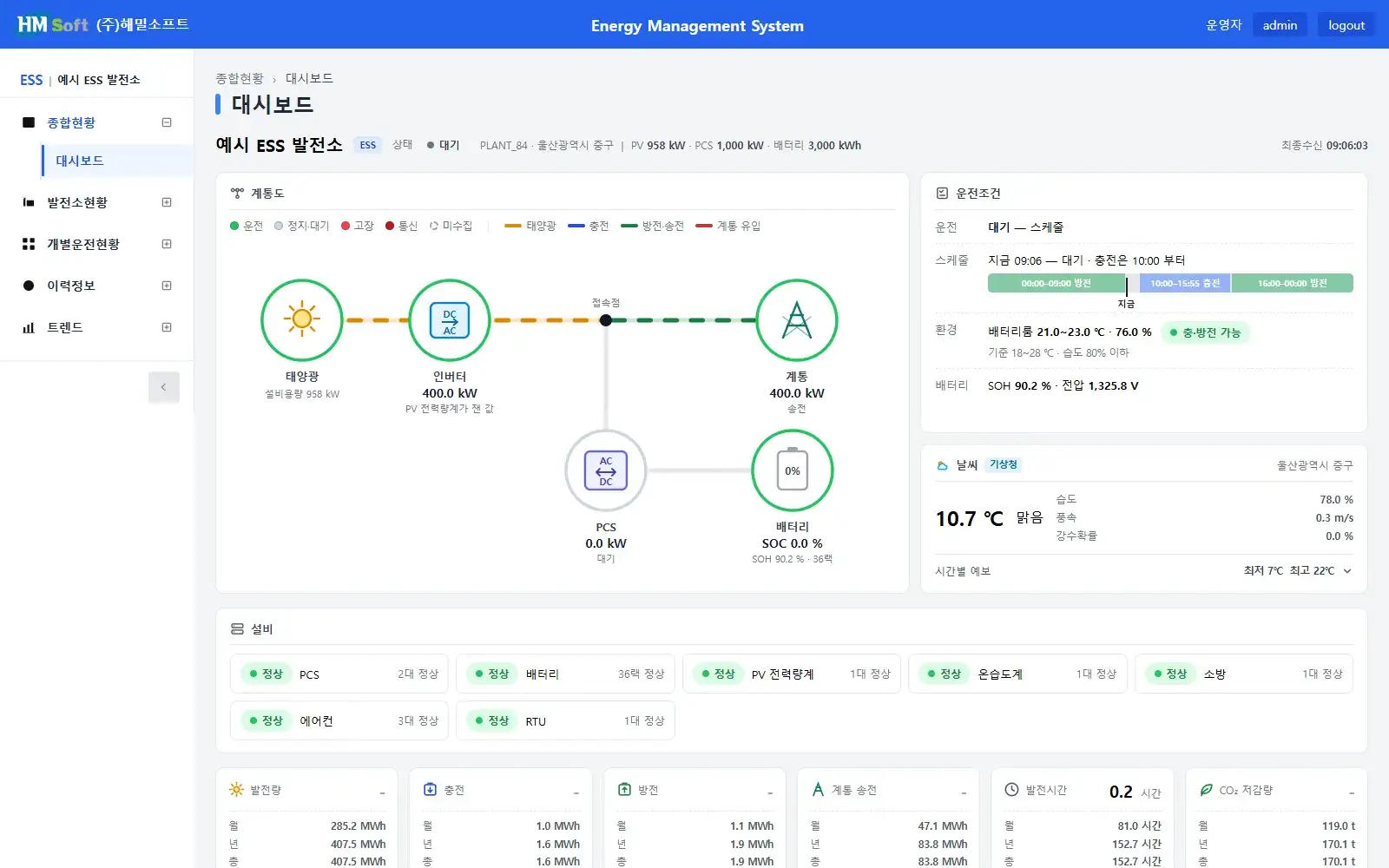
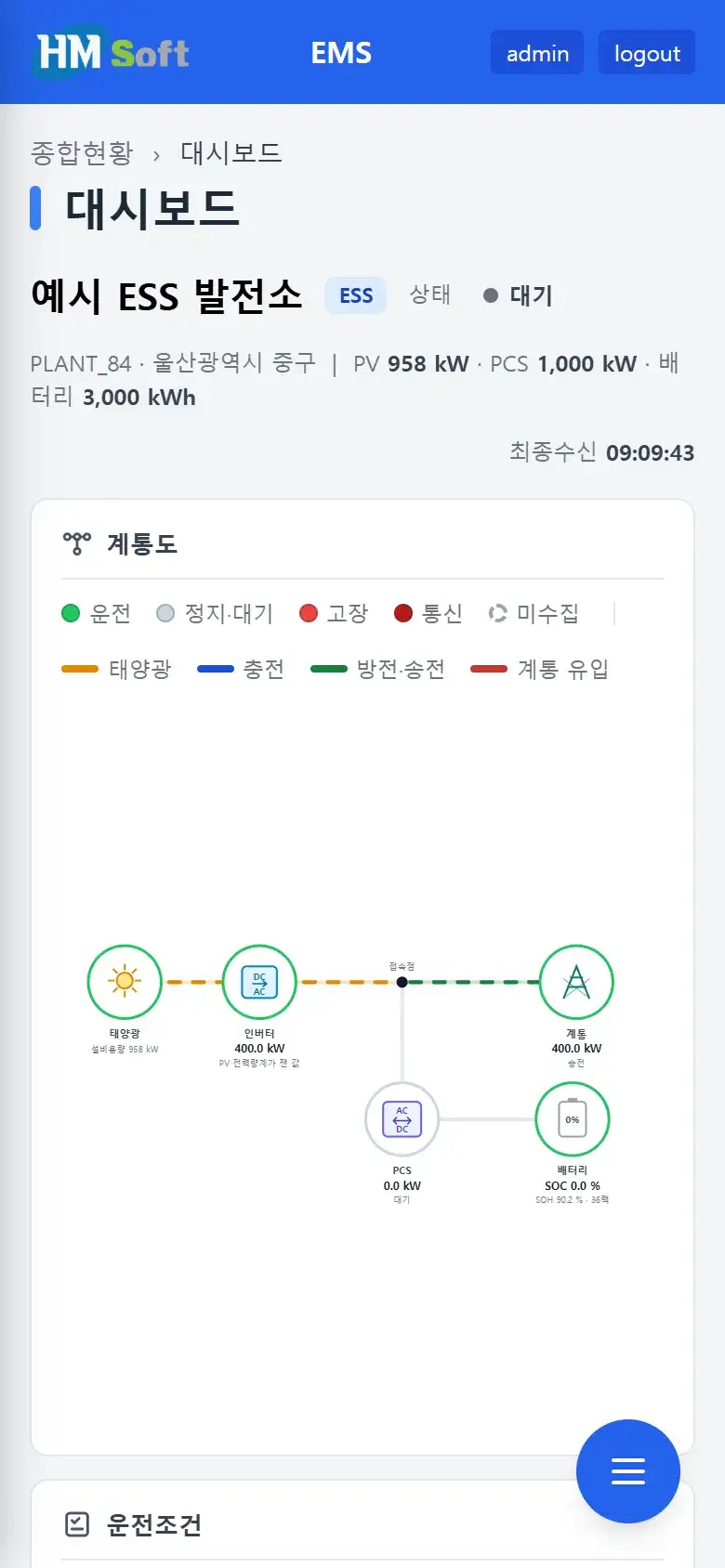
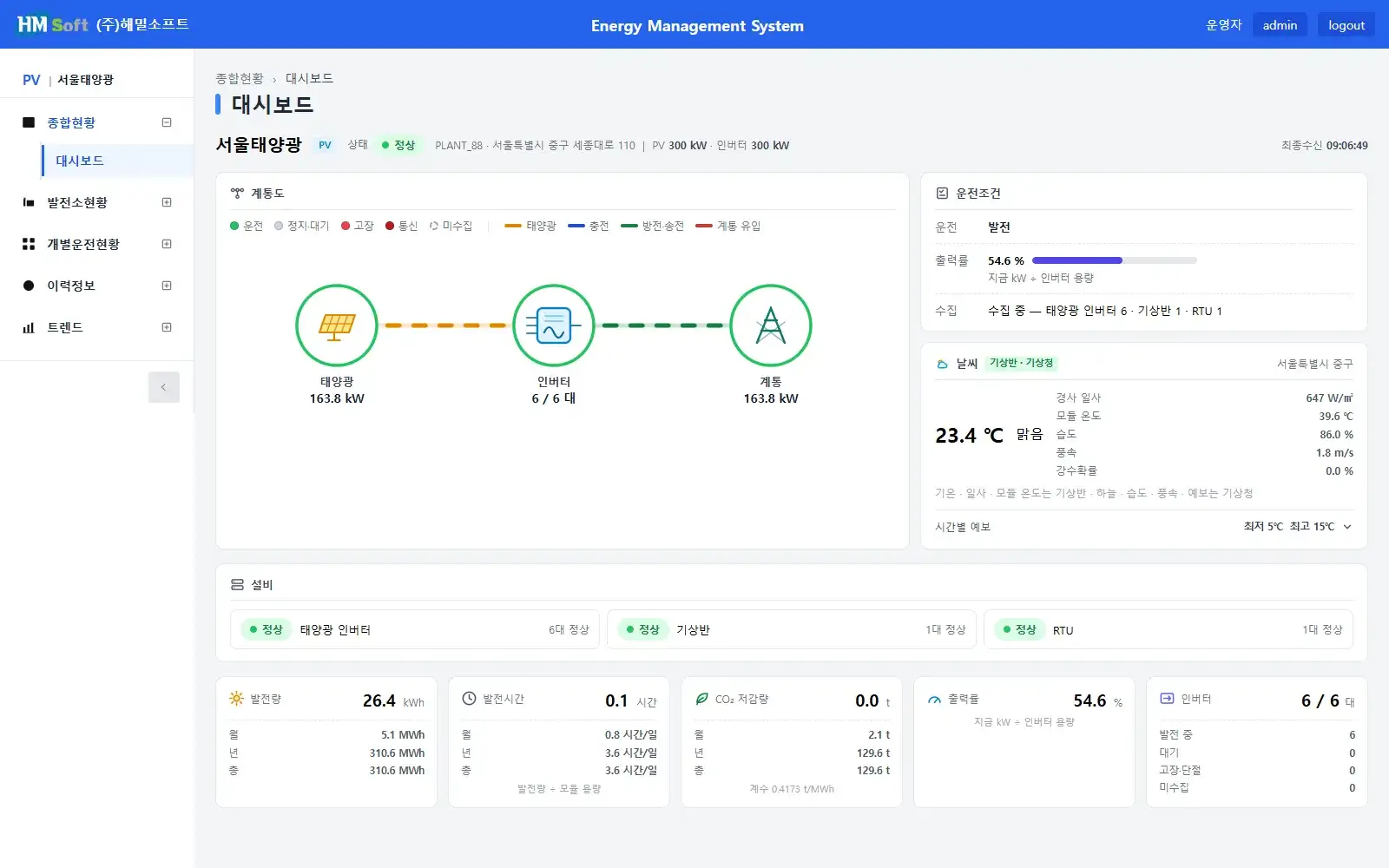
Screenshots are from the Korean user interface with demo data.
ESS EMS
Runs charging and discharging of PV-linked ESS based on time of day and equipment state. Whenever something cannot be confirmed, it chooses to stop.
Charge/discharge schedule
Set charge, discharge and standby by time slot for each plant. If the schedule cannot be received, the plant does not run.
Power and SOC limits
Per-plant charge/discharge power caps, SOC range and level control decide «how much» to charge or discharge.
PV-following charging
Collects every 0.2 seconds and updates the charge command within 0.4 seconds when PV output changes — so the battery is never charged from the grid.
Partial PCS fault operation
With several PCS units, only the faulty one is taken out and the command is shared among the rest so operation continues.
Automatic fault recovery
Attempts PCS fault resets at a set count and interval. Never sent for emergency stops or fires.
Battery room climate & HVAC
Stops charging and discharging when the plant’s temperature/humidity limits are exceeded, and sets the air conditioner temperature remotely.
Fire system link & emergency stop
On fire equipment faults or fire detection, stops in the order «PCS 0 kW → verify current → open battery relays».
Battery protection
Watches rack and module status and cell voltages, and applies voltage and SOC protection suited to each battery type.
PV Monitoring
Looks at inverters, strings and the weather station together to find the equipment that is «low on its own» under the same sunlight.
Inverter sibling comparison
Compares output ratios among inverters in the same plant and flags those clearly below the median.
Broken string detection
Checks current per string to find broken ones — and tells «not connected» apart from «broken».
Performance ratio (PR)
Calculates performance from plane-of-array irradiance and inverter yield, and points out the low days.
Weather station link
Collects module temperature, ambient temperature, and tilted and horizontal irradiance.
Trends & reports
View yield and generation hours by day, month and year, and download reports as files.
3 major inverter makers
Integrated with three major domestic and global PV inverter makers; other models can be added given a communication spec.
Tracking · agrivoltaic
Generation is monitored on today’s screens as is. Trackers (angle per row · stow · alarms) are added once we receive the controller’s communication spec — in development.
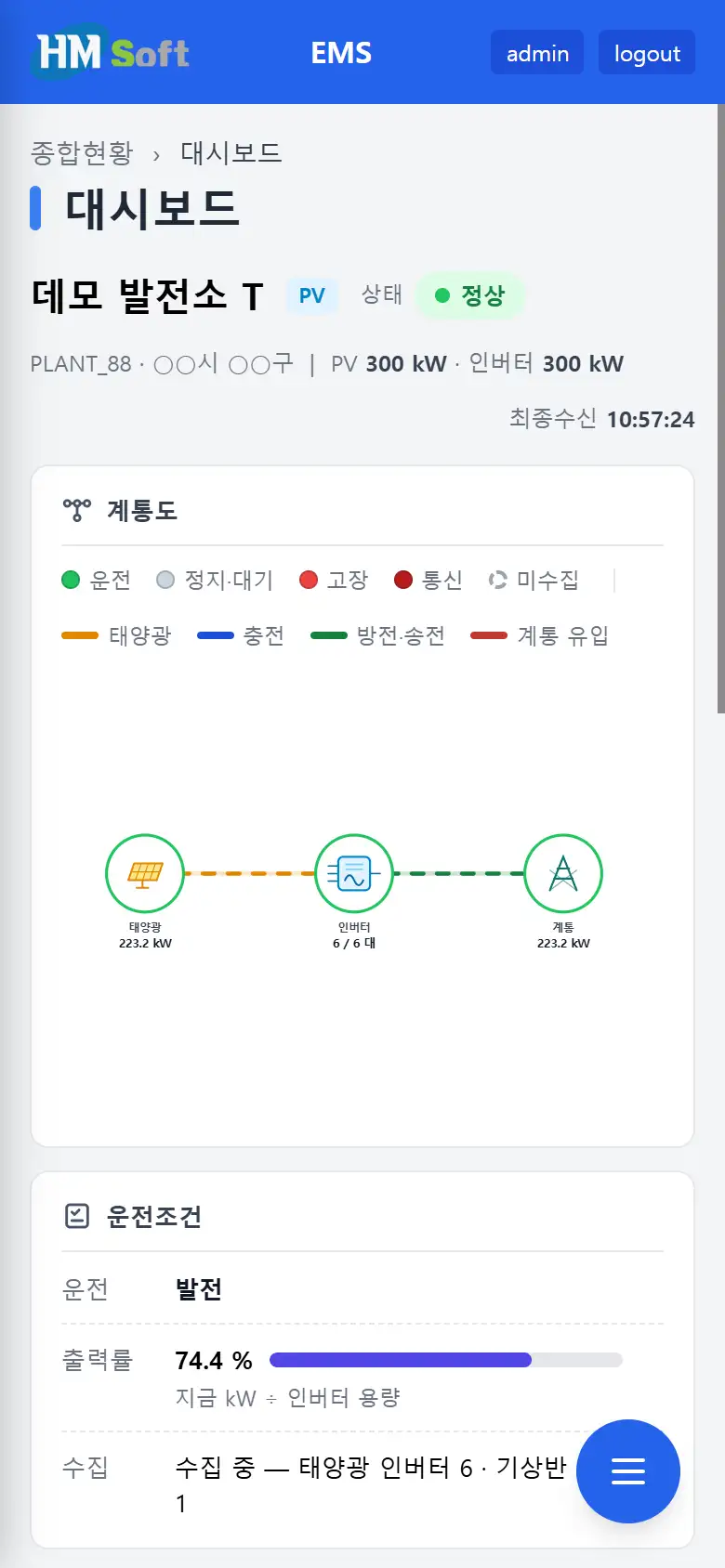
Integrated Control
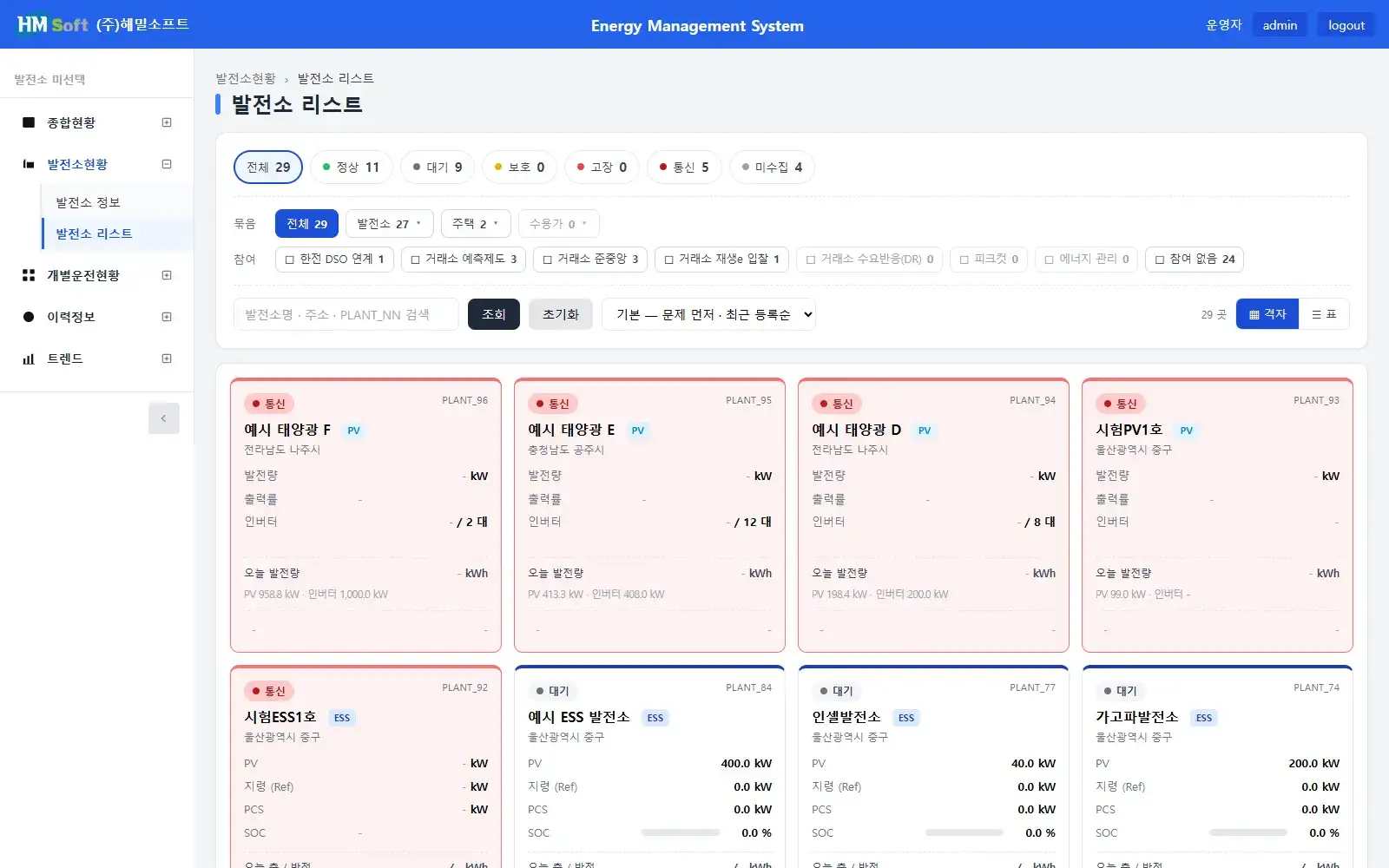
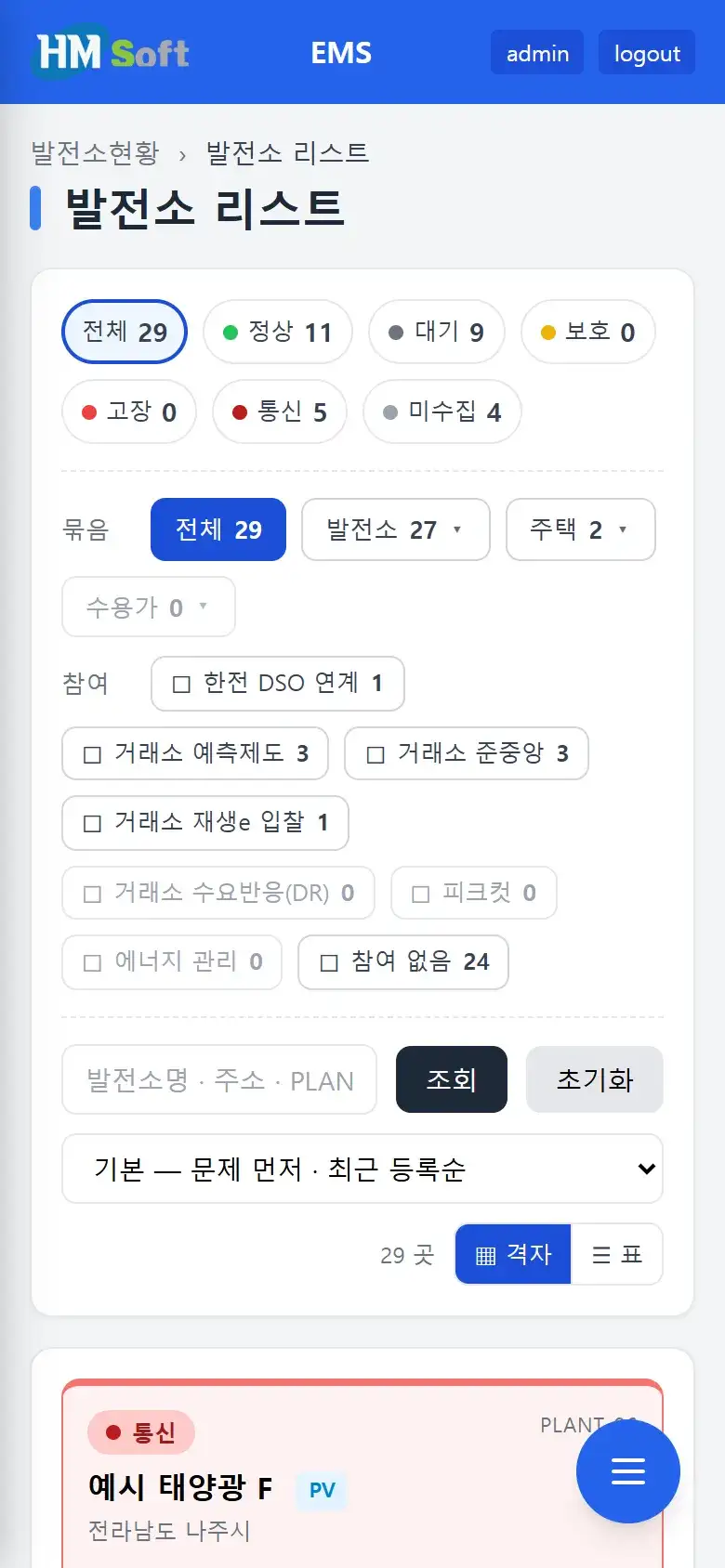
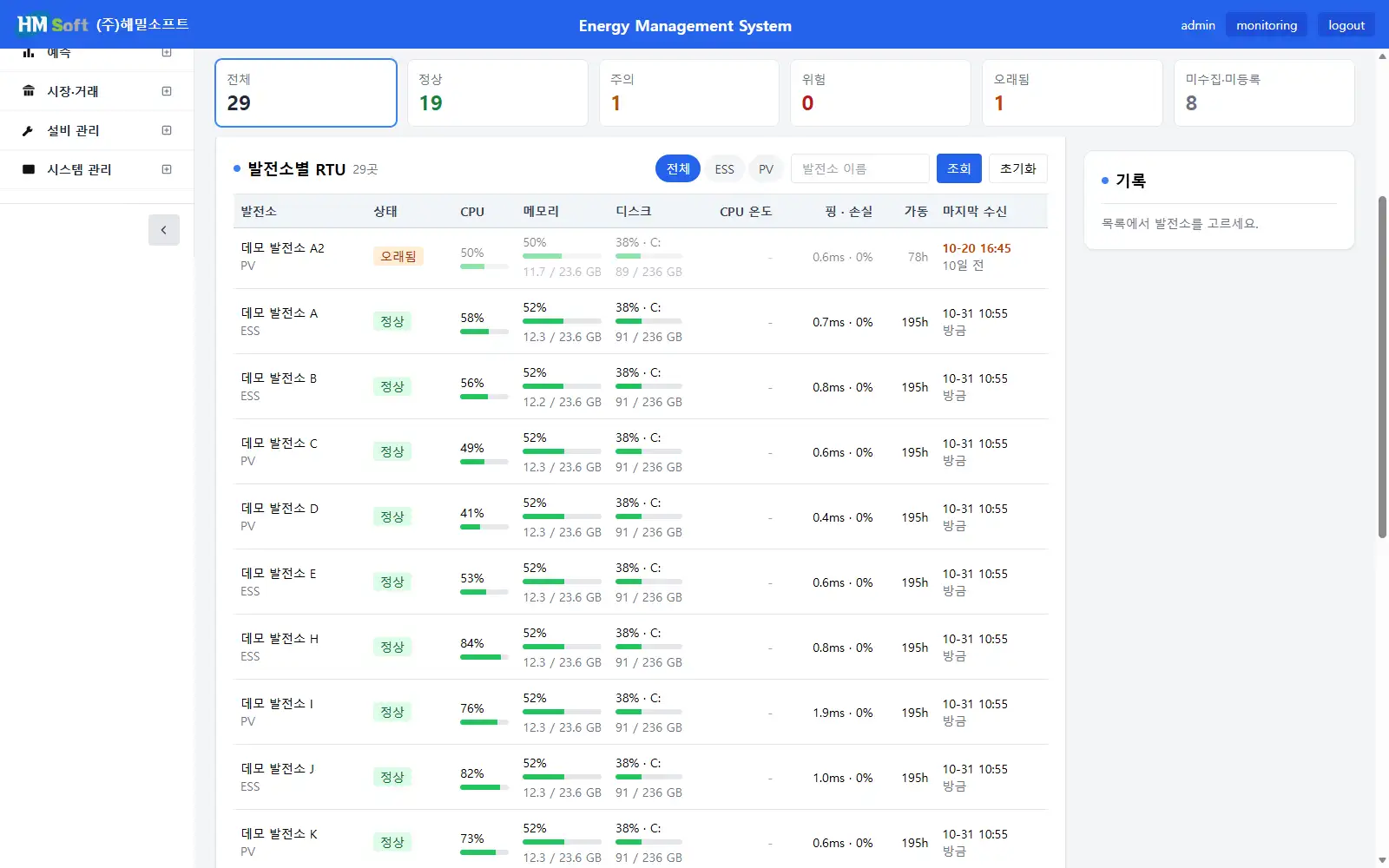
See hundreds of plants on one screen, with the plants in trouble shown first.
All plants at a glance
Operation, communication and field PC status of every plant in one table — picking out the ones that need attention.
Mobile alerts
When charging or discharging stops abnormally, the operator’s phone is alerted at once. Web push — no app to install.
Operation, fault & alarm history
Keeps equipment state changes and human control actions for one year, searchable on screen.
Permissions & plant access
Four user roles (super admin · admin · user · guest), with the plants each person can see set individually.
View by portfolio & scheme
Filter the plant list by portfolio and by scheme (KEPCO DSO · exchange forecasting …).
Data retention
10-minute raw data for 1 year · hourly summaries for 5 years · monthly backups for 10 years.
KESCO reporting
Automatically sends the ESS operating data required by the Korea Electrical Safety Corporation and keeps a transmission log.
One alert when it’s «on our side»
When many plants go quiet at once, it is treated as a server or network issue — one alert, not hundreds. The health of our five servers is on screen too.
VPP Operator System
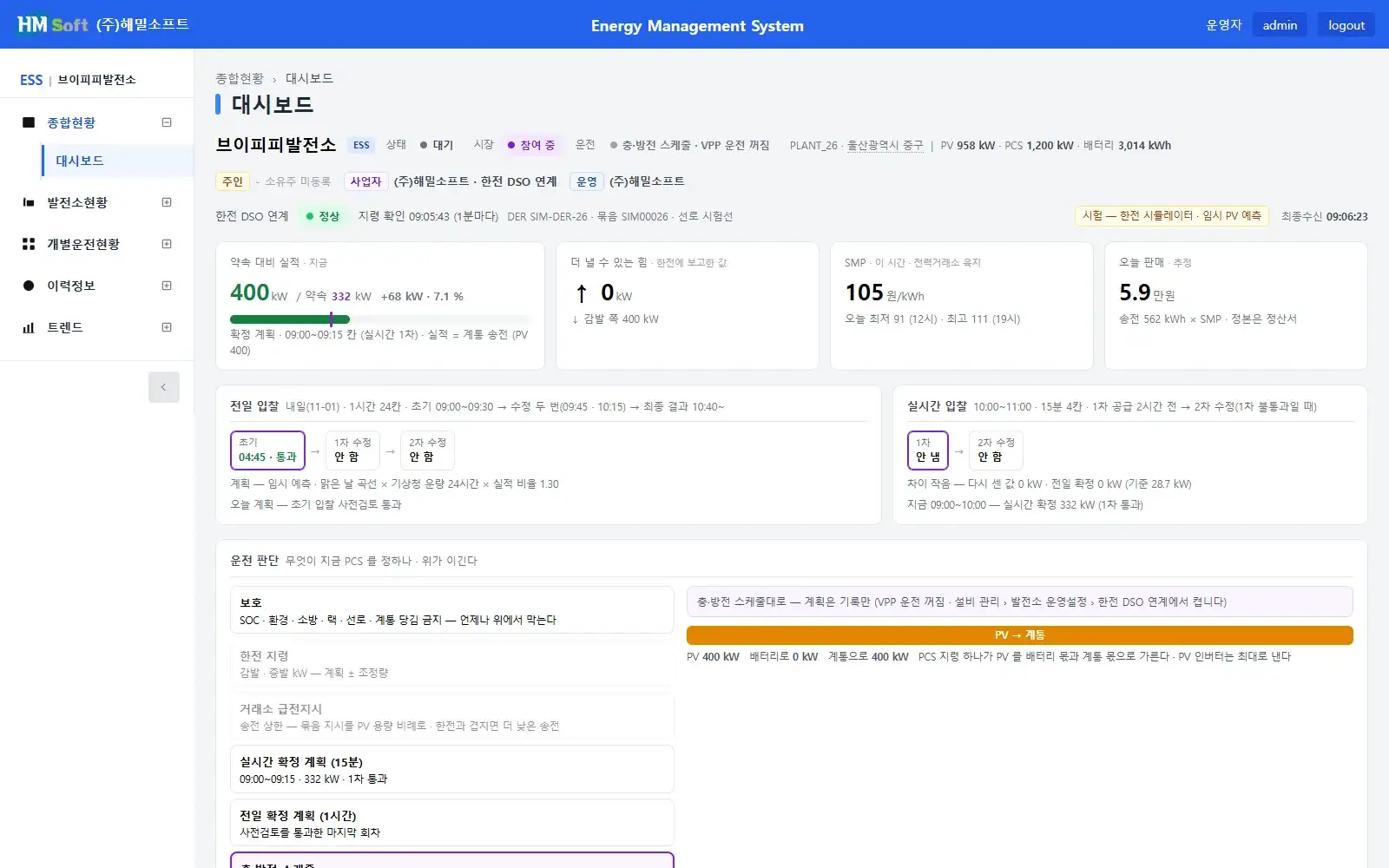
Runs scattered solar, ESS and heat pumps as one power plant, linked to KEPCO and the Korea Power Exchange — based on the Korean VPP standard KSGA-025-19.
KEPCO DSO link
Registration, one-minute curtailment polling, metering reports and feeder flexibility («more / less» at hours KEPCO requests in advance) per Part 2 of the standard (KSGA-025-19-2). Built; grid tests are being prepared.
Day-ahead & real-time bids
Builds day-ahead and 15-minute real-time plans automatically from PV forecasts and ESS SOC, with revised bids if a plan fails review. Charge and discharge are worked out in the same order as the on-site EMS, so plans and real operation line up.
Exchange forecasting scheme
Makes day-before forecasts at 10:00 and 17:00 and estimates the hourly payment by error band. In trial operation — recorded daily on the live server.
Exchange dispatch
Semi-central and RE bidding — records exchange instructions and judges whether the solar portfolio followed them. In trial operation with PV test portfolios.
Generation forecasting
Forecasts the next 24 hours from KMA forecasts and the last 90 days of actuals, scored daily by the exchange’s yardstick.
Multiple operators
Each operator has its own utility codes, keys, portfolios and screens. A plant can join several schemes at once.
Protection first
Whatever the order, battery, fire and climate protection is decided on site first; if the link drops, the confirmed plan takes over.
Field RTU
Our own collector runs on one industrial PC per plant, talking to and controlling the field equipment directly.
Direct device communication
Talks to batteries, PCS, inverters, power meters, weather stations, HVAC, fire systems and heat pumps over Modbus TCP, serial (via converter or direct) and CAN.
Auto recovery after outages
When power returns, the field PC turns itself on and the collector starts automatically.
PCS standby before shutdown
Before the collector goes down, it first puts the PCS on 0 kW standby.
Field PC health
Reports CPU, memory, disk and auto-start settings to the server for viewing on screen.
Heartbeat monitoring
Reports «alive» every 10 seconds; if it goes silent, the operator is alerted within a minute.
Keeps recording when cut off
If the link to the server drops, readings are kept on the site PC for up to 7 days and filled into the history once it reconnects. Meanwhile ESS charging and discharging stop safely.
Encrypted VPN · LTE
Each plant connects to the server over its own encrypted VPN. Remote solar sites without a wired line run on LTE alone — data is batched and compressed to save the plan.
Business areas
From ESS, solar, microgrids and distributed generation to VPP, power trading, heat pumps, factories and buildings — what we do and our track record are under Solutions.